Chess Solid Icons: A Designer's Review for Embroidery
When I first pulled up the Chess Solid Icons on my screen, my immediate reaction wasn't just about the aesthetic; it was about the stitchability. As someone who spends hours hooping fabric and threading needles, I look at graphics differently than a web designer might. Where they see pixels and vectors for a mobile app, I see potential satin stitches, fill densities, and the risk of thread breaks on a curved cap. The product description promises a "simple and clean icon design," and in the world of machine embroidery, simplicity is often the highest form of sophistication. These Icons and Graphics are pitched for websites and print, but I wanted to know: how do they translate when turned into a tangible embroidery project?
The Visual Personality and Stitch Potential
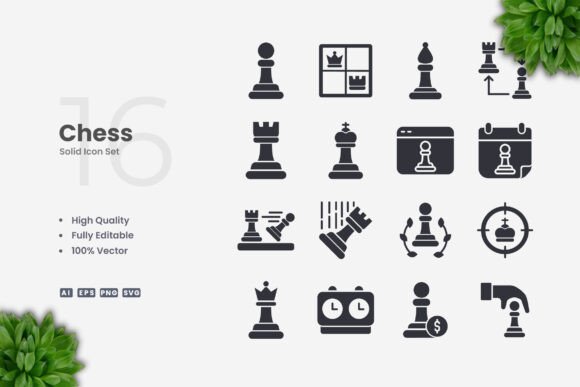
The mood created by Chess Solid Icons is one of classic strategy and timeless elegance. Chess is a game of intellect, and these designs reflect that with their solid, bold shapes. There is no unnecessary clutter here. For an embroidery designer, this is a dream scenario. Complex gradients and tiny details that look great on a high-resolution monitor can be a nightmare under a needle. These icons rely on strong silhouettes—the distinct shape of a knight, the sturdy base of a rook, the recognizable crown of a queen. This visual personality suggests that they would perform exceptionally well as a fill stitch application. Because the shapes are solid, you aren't fighting with micro-details that might get lost in the fabric texture.
However, since the source files are described as editable vectors, the responsibility falls on us, the digitizers or embroiderers, to ensure the transition from screen to thread is handled correctly. The "clean" nature of the design means there is a lot of room to interpret how the light hits the threads. A flat fill stitch might look too static, whereas adding a slight contour or varying the angle of the stitching could bring out the three-dimensional quality of the chess pieces. The layout is straightforward, which makes it versatile for everything from a single chest logo on a polo to a repeating pattern on a tote bag.
Real-World Application: The Boutique Sweatshirt Scenario
To truly test the viability of Chess Solid Icons, I imagined a specific real-life scenario: a custom order for a local chess club needing branded apparel for an upcoming tournament. They wanted something modern, not the typical clip-art look found on cheap promotional items. I envisioned using these icons on a heavyweight cotton blend sweatshirt. The goal was to create a handmade product that felt premium.
In this context, the solid nature of the icons works in our favor. On a sweatshirt, which has a bit of nap and texture, a design with too many fine lines would disappear. The bold shapes of the chess pieces stand out clearly against the fabric. If I were producing this, I would likely choose a matte thread finish rather than a high-sheen rayon to maintain that "solid" look described in the product features. The result would be a piece of custom apparel that looks professional and intentional. Customers receiving these items would likely perceive higher value because the design doesn't look like a generic transfer; it looks like it was built into the garment.
Beyond apparel, these Graphics would shine on home goods. Imagine a set of kitchen tea towels or a pillow cover for a study or library. The intellectual theme of chess pairs perfectly with home decor. An embroidered patch featuring one of these icons could be sewn onto a canvas tote bag design, creating a durable accessory for carrying books or chess sets. The versatility allows a small shop product line to expand quickly without needing entirely new design assets.
Navigating Fabric Challenges and Hoop Limitations
While the design is clean, practical judgment dictates we must consider where things could go wrong. Even simple icons have limits. If you are working with a very small hoop size, say for a baby hat or a pocket logo, you need to be careful with the internal details of the pieces, like the horse's mane on the knight or the gaps in the rook. If the design is scaled down too far, these areas might merge, causing the stitch density to become too high for the fabric to support. This is crucial for baby embroidery, where softness and safety are paramount; a dense block of stitching on a onesie can be uncomfortable.
Textured fabrics also present a challenge. While the solid shapes are forgiving, stitching on a highly textured towel or a fuzzy fleece requires a robust stabilizer. Without it, the clean edges of the Chess Solid Icons might sink into the pile of the fabric, losing their crisp definition. Similarly, on stretchy fabrics like performance tees or caps, the curvature can distort the straight lines of the board or the base of the pieces. When working on a cap, the center of the design must be perfectly aligned, or the perspective of the chess piece will look off to the human eye, even if the file is perfect.
Dark fabrics offer another consideration. The description mentions the ability to change colors easily in vector format. This is vital for embroidery. You cannot simply rely on the default black or white. For a navy blue jacket, you might need a cream or gold thread to ensure contrast. Testing the design in black and white mockups before stitching is a smart move to verify that the silhouette holds up without relying on color differentiation.
Elevating Brand Value and Customer Trust
For an Etsy seller or a creative entrepreneur, the choice of design assets directly impacts brand consistency. Using Chess Solid Icons across different products—from aprons to holiday gifts—creates a cohesive look. When a customer sees the same clean, professional icon on a wedding gift and a promotional banner, it builds trust. It signals that the maker pays attention to detail. In the realm of commercial embroidery, professionalism is the currency. A blurry or poorly adapted design can ruin a reputation, but a crisp, well-executed icon enhances the perceived quality of the finished product.
These designs also have high "giftability." Chess is a popular theme for fathers, grandfathers, and strategy lovers. A personalized item featuring these icons feels thoughtful. Whether it is a holiday embroidery project for a stocking or a year-round boutique item, the classic theme ensures it won't go out of style next season. This longevity is key for makers who want to create inventory that sells over time.
Practical Notes for the Embroidery Studio
Before committing to a production run with Chess Solid Icons, here are a few essential steps I recommend based on experience:
- Test on Scrap First: Always stitch a sample on the exact fabric you intend to use. Check how the thread colors interact with the material.
- Check Stitch Density: Ensure the solid areas aren't too dense, which can cause puckering, especially on lighter fabrics.
- Verify Licensing: The product description mentions use for print and web, but always confirm the license terms before selling digital embroidery file adaptations or finished commercial goods.
- Inspect Small Details: Look closely at the vector file for any tiny gaps that might not stitch out well and may need bridging in your digitizing software.
- Stabilizer Selection: Match your stabilizer to the fabric weight. A heavy cut-away might be needed for stretchy garments to keep the icon sharp.
- File Formats: Since the description highlights vector editing, ensure you have the correct software to convert these design assets into a usable machine embroidery design format compatible with your specific equipment.
In conclusion, Chess Solid Icons offers a strong foundation for a variety of creative projects. Their simplicity is their strength, allowing them to adapt to everything from a delicate applique design on a nursery blanket to a bold statement on a team jersey. With careful attention to fabric choice, stabilization, and scaling, these graphics can be transformed into stunning embroidered works that elevate any craft business. They are a reminder that sometimes, the most effective designs are the ones that let the quality of the stitching speak for itself.